Who Will Own the Waste?
A call for a multi-stakeholder accord on Bangladesh’s textile waste sector
By Shamiul Hoque, Dhaka, Bangladesh
In brief
Bangladesh’s textile waste sector will not formalise through more policy papers. It will formalise when the people who buy from Bangladesh, the people who govern it and the people who work in it sign up to one shared, binding commitment, as they did after Rana Plaza.
Every year the country’s garment factories generate an estimated 400,000 to 577,000 tonnes of pre-consumer waste, known locally as jhut. Around two-thirds leaves the country raw, only a single-digit share is recycled at home, and at the factory gate the trade is controlled by locally powerful groups.
Since 2021 there has been no shortage of diagnosis, yet very little has moved. The paper proposes something different in kind: a multi-stakeholder accord for the textile waste tier, working name the Bangladesh Textile Waste Accord, running on two tracks as the response to Rana Plaza did.
Brands and retailers must formally recognise waste handlers as part of their value chain. Everything else follows from that.
The problem in numbers
Figures as given in the paper, with their sources. Where a figure is an estimate or the author’s own observation, the paper says so.
- 400–577ktonnes of pre-consumer textile waste (jhut) generated in Bangladesh each yearPublished estimates (Circle Economy and the Labour at Informal Economy Society, 2026)
- 176–214kpeople working in the jhut economy, across 12 clusters in ten districtsEstimate by Circle Economy and the Labour at Informal Economy Society (2026)
- Two-thirdsof jhut leaves the country raw. Only a single-digit share is recycled in BangladeshBy most estimates; no unified national data exists
- 84%of waste traded through Reverse Resources’ traceability platform went to recyclers in India. Only 4% stayed in BangladeshTraced trade only, April 2025 to April 2026; not national figures
- 50+violent clashes over control of jhut since the change of governmentAs reported by Bonik Barta (June 2026)
- 30–70%mark-up between the factory gate and the handler’s warehouse, for no added valueThe author’s observation of the trade; varies by area, grade and season
The proposal: eight commitments
A multi-stakeholder platform that brings buyers, industry, workers, civil society, development partners and government into one set of binding commitments for the waste tier. Not another study, pilot or coordination forum: its members commit to doing things together, and can be held to them.
Recognise the waste tier
Brand and retailer members formally declare that the handlers, traders, sorters and recyclers who receive their suppliers’ waste are part of their value chain and due diligence.
Remediate, don’t exit
Members stay and fund improvement instead of cutting off handlers or banning suppliers from selling to them.
Channel waste through participating handlers
Over an agreed phase-in, suppliers sell waste to handlers in the Accord’s programme, which gives factories cover to say no to the gate.
Make formal cost no more than informal
Members share the cost of formalisation through contributions, commercial commitments and joint advocacy on any remaining tax penalty.
Verify independently and publish
Handlers are assessed against a common standard covering registration, labour law, safety, waste handling and traceability, and progress is published.
Give workers a voice
A confidential grievance mechanism, protection against retaliation, district-level worker platforms and seats in governance.
Build one shared data layer
A common, permissioned traceability record from factory to recycler, owned by the Accord and open to any compliant technology provider.
Hand over to a national institution
A clear path, from the start, to a tripartite Bangladeshi body, as the Accord’s work passed to the RSC.
Two tracks, as in 2013
After Rana Plaza, brands and unions signed the binding Accord while the EU, the US, the ILO and the Government of Bangladesh signed the Sustainability Compact alongside it. Each track gave the other its force.
Convened by Team EuropeThe EU Delegation with the Netherlands, Denmark and Germany (BMZ and GIZ), funding the start-up phase.
Track 1
The binding accord
Signed by
- Brands and retailers
- Unions and labour foundations, anchored by BLF and Mondiaal FNV
- Industry: BGMEA, BKMEA, BTGWPEA
Commits to
- Recognise the waste tier
- Remediate, don’t exit
- Channel waste through participating handlers
- Share the cost of formalisation
- Independent checks, published, and a voice for workers
Track 2
The government compact
Signed by
- Government of Bangladesh
- Team Europe
Commits to
- Waste-tier recognition in the National Circular Textile Strategy
- Remove any remaining tax penalty on traceable trade
- Protect participants from intimidation
- Recognise the Accord’s standard
Shared foundationsOne open data layer · Independent verification · A planned handover to a national tripartite body
The next 12 months
The first year should produce one thing: a signed founding commitment from enough buyers, workers’ organisations and industry bodies to make the Accord real.
Now to December 2026
Get waste-tier recognition written into the National Circular Textile Strategy before it is finalised. Team Europe convenes a small founding group of brands, unions, industry bodies and development partners.
January to March 2027
Open talks with International Accord signatories and the RSC on an addendum, with the ILO on the labour standard and with government on the compact.
April to June 2027
Draft the handler standard and the phase-in with workers’ organisations, handlers and recyclers. Agree cost-sharing and the open data layer.
July to September 2027
Sign the founding commitment and the government compact, starting with one or two industrial hubs such as Gazipur and Narayanganj.
Inside the paper
- The problem as it is
- Who actually runs jhut
- Why five years of good recommendations have not worked
- The recognition gap: why brands look away
- What Rana Plaza taught us
- The proposal: a multi-stakeholder accord for the waste tier
- Who must be at the table
- Where it could live
- Hard questions, honest answers
- The ask: the next 12 months
Plus a summary, acknowledgements, 22 numbered sources and a note on the author.
How to cite
Hoque, S. (2026). Who Will Own the Waste? A call for a multi-stakeholder accord on Bangladesh’s textile waste sector. Version 1.0. shamiulhoque.com
Part 3 of Who Will Own the Waste?, a four-part series published on LinkedIn in October 2026. Parts 1 and 2 set out the problem and why five years of recommendations have not moved. This paper sets out the proposal.
Written in a personal capacity, but not in isolation. Shamiul works full time at Reverse Resources, and the paper draws on data, field experience and access to information he has through that work. Its ideas are aligned with Reverse Resources’ work on traceable, formal trade in textile waste. The views, and any errors, are his own, and do not necessarily represent SusNex or any other organisation he works with.
© 2026 Shamiul Hoque. You are welcome to share this paper in full, with attribution. Please get in touch before quoting it at length or adapting it.

About the author
Shamiul Hoque is a sustainability and circular economy leader based in Dhaka, Bangladesh, with more than 24 years of experience across finance, textile sourcing, sustainability, traceability and circular economy programmes. He is Head of International Business Growth at Reverse Resources, Director of Sustainability Programs at SusNex and a guest lecturer at the University of Dhaka.
He works with brands, manufacturers, recyclers, industry bodies and development partners on material transparency and on moving post-industrial textile waste towards higher-value recycling.
Related publication
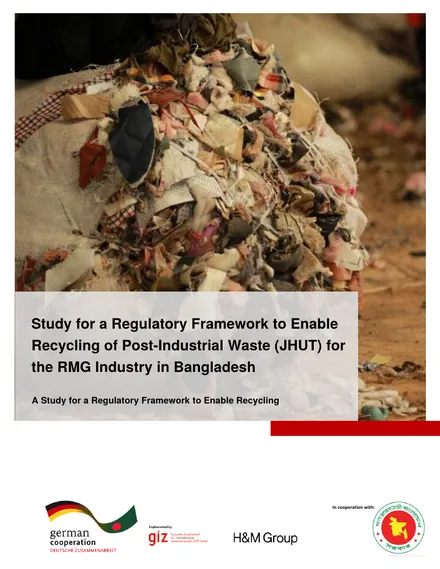
Study for a Regulatory Framework to Enable Recycling of Post-Industrial Waste (Jhut) for the RMG Industry in Bangladesh
Shamiul Hoque, Muhammod Shaheen Chowdhury, Mamunur Raman, Patrick Schröder